
How to Choose an Mpox PCR Test for High-Throughput Molecular Laboratories
Rapid amplification cannot compensate for a specimen outside an assay’s scope or an unsupported instrument configuration. High-throughput molecular laboratories therefore face several eligibility questions before comparing minutes or reaction positions.
A monkeypox test needs a defined starting material, an executable analytical programme and an acceptable finding at the end. Selection brings those requirements together, establishing whether the proposed combination can supply the required MPXV information at the intended scale.
Set Eligibility Conditions Before Ranking Speed
Specimen scope, instrument support and the required output form concurrent selection conditions. None can compensate for an unresolved requirement elsewhere: additional reaction positions cannot establish suitability for an unlisted specimen, while an accepted specimen does not establish an instrument’s ability to execute the method. A candidate mpox PCR test can be assessed against all three conditions before its running time receives a purchasing weight.
The submitted matrix belongs in that initial assessment because collection material and prepared reaction input describe different things. The chosen preparation must connect them under appropriate conditions. A laboratory evaluating a monkeypox test consequently needs more than a list of accepted specimens; it also needs an applicable route from its own incoming material to the template delivered for amplification.
Instrument eligibility concerns the particular combination of assay programme and detection configuration. A thermal cycler can offer enough positions while leaving unanswered whether the proposed fast programme and fluorescence requirements are supported. The relevant evidence identifies the actual equipment and operating configuration, allowing an unsupported combination to be distinguished from one ready for assessment under the selected method.
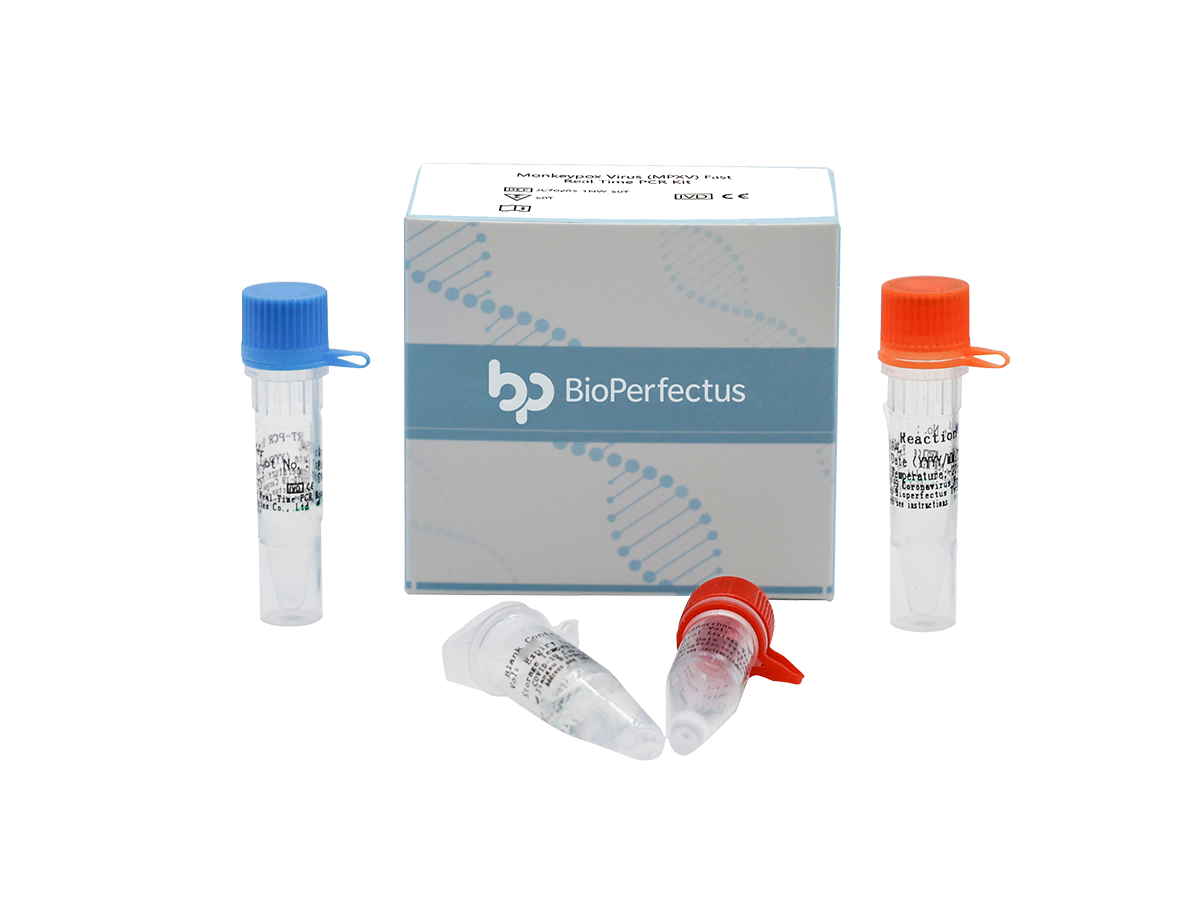
Against those joint requirements, the Monkeypox Virus (MPXV) Fast Real-Time PCR Kit from BioPerfectus offers qualitative detection of MPXV nucleic acids. That output defines the analytical purpose against which specimen and platform suitability can be examined. The selection question concerns completing this particular molecular examination, without expecting a qualitative assay to provide a separately established viral-load measurement.
Read the Fast Configuration as a Conditional Capability
The product’s fast configuration supplies concrete details for the eligibility review. Hydrolysis-probe real-time PCR detects two MPXV genes in one reaction tube. Target amplification and fluorescence observation belong to the same analytical procedure, with the assay’s interpretation determining the accepted finding. Two targets describe the design of that procedure rather than an unrestricted claim about every possible viral sequence.
Supported human materials include tonsillar swabs, nasopharyngeal swabs, serum, whole blood, lesion exudate and scabs. The BioPerfectus assay specifies a 10 µL input. That aliquot concerns material supplied to the assay; it does not specify how much original specimen to collect or establish a common preparation procedure for every listed matrix.
Fast amplification is completed within 30 minutes, with up to 96 results on a compatible system. Both qualifications belong in an mpox PCR test comparison. The interval describes the fast amplification procedure, while the scale refers to the supported system arrangement. Collection, preparation and report release remain separate operations whose durations are not established by that amplification figure.
An internal process control contributes evidence for interpreting the procedure. Its assessment accompanies the target observations under the applicable instructions, including any action required when process evidence is unresolved. A nominal result position therefore becomes useful only through an acceptable analytical observation; the capacity statement alone cannot establish a guaranteed number of reportable patient findings.
Accept the Proposed Combination Within a Defined Scope
Local acceptance examines the complete combination the laboratory intends to introduce. Representative materials can cover the specimen categories actually assigned to the service, with preparation, reaction setup and interpretation assessed at their relevant points. This exercise establishes evidence for the proposed use without turning the product’s specimen list into a claim that every matrix behaves identically.
An acceptance exercise also needs a clearly declared endpoint before it begins. Predefined observations and decision rules make a favourable outcome distinguishable from a partial demonstration, keeping the evidence limited to the specimens, equipment configuration and analytical functions that were actually included in that local assessment.
Preparation observations and amplification observations answer different acceptance questions. Target loss or carried-over inhibition can affect the receiving reaction, so an investigation needs to identify which operation produced the discrepancy. Assessment of a monkeypox test can retain that distinction instead of treating every unsuccessful analytical attempt as evidence that more amplification positions are needed.
The supported fast programme also requires a clearly identified equipment configuration. Acceptance records can retain the programme used, the material examined and the resulting control assessment. Subsequent changes to those elements can then be located within the established evidence, rather than disappearing behind an unchanged assay name or a familiar instrument capacity label.
For the BioPerfectus method, the published speed and result count remain attached to fast amplification on a compatible system. Evaluation of an mpox PCR test can ask whether the laboratory’s intended combination preserves those conditions while producing the required accepted findings. That question can be answered without inventing a daily output from the maximum stated result count.
A candidate passes selection when its specimen, platform and output requirements hold together. Speed contributes to that decision after the underlying combination has an evidential basis, while unresolved conditions remain identifiable before routine use. A fast amplification programme earns its place within a supported combination that meets the service’s specimen and reporting requirements.